
What North Carolina's Election and Duke Energy's Earnings Mean for Your Power Bill

What North Carolina's Election and Duke Energy's Earnings Mean for Your Power Bill
North Carolina voted Tuesday, and Duke Energy reported earnings Thursday, giving the clearest picture yet of what your power bill will look like next year.
The election settled into a new map, but nothing is final yet
As of Friday morning, the Associated Press had called nine of North Carolina's fourteen U.S. House races, all for Democrats. Five are still uncalled, including the two closest: in the 3rd District, Republican Greg Murphy leads Democrat Raymond Smith by 233 votes, and in the 5th, Democrat Chuck Hubbard leads Republican Virginia Foxx by 99 votes. If the remaining leads hold, the delegation flips from ten Republicans and four Democrats to ten Democrats and four Republicans.
Nothing is certified until November 13, and recounts are possible in the closest races. But the winners who spoke about data centers mostly said the same thing: growth is fine, but households and small businesses should not pay for it. Roy Cooper, who won the U.S. Senate race, campaigned on local communities having the final say and data centers paying all of their own energy costs. What the winners actually said, in our election post: https://www.mcmgs.com/blog/nc-election-2026-data-centers-power-bill
For your business, the people who will write the next round of energy and zoning rules are now mostly in place, and most of them campaigned on the side of the ratepayer. The fight over who pays for new power plants will now happen in public, in hearings and votes you can show up to.
Duke Energy beat expectations, and the big numbers are about data centers
Duke reported third-quarter earnings of $1.99 per share, up from $1.81 a year ago, on revenue of $9.10 billion, beating the roughly $1.86 consensus estimate. Duke narrowed its full-year guidance to $6.70 to $6.80 per share.
The numbers that matter most are the pipeline figures: Duke has signed agreements covering about 7.8 gigawatts of data-center demand, with about 5.2 gigawatts tied to projects already under construction, and it expects to convert its full 15.4-gigawatt late-stage pipeline into agreements by the first half of 2027.
On the call, Duke said it expects North Carolina orders on its rate cases and the large-load tariff by mid-November, with new rates taking effect in January 2027. The settlement, signed by Amazon, Google, Meta, and Microsoft, would make new large loads pay upfront for their own grid connections. The Utilities Commission has still not ruled, so it is still a proposal, not a decision. Duke also prefiled permits for about 2,800 megawatts of gas generation at the Davie-Davidson site.
For your business, the practical move is to know what your energy costs are and plan for them to move. A business that tracks its costs in one place and automates the repetitive work around them adapts faster than one that finds out from a bill. If that is a project you want help with, that is what we do: https://www.mcmgs.com/contact
Davidson County votes Monday, and today is the last day to weigh in
The Davie-Davidson Energy Complex comes to a vote Monday, November 9, at 6 p.m., when the Davidson County Board of Commissioners holds its public hearing in Lexington. The project is two methane gas plants of about 1,360 megawatts each in Davie County, a liquefied gas storage facility in Davidson County, and a pipeline under the Yadkin River, covering about 1,600 acres of rural farmland.
Opponents are asking the board to defer the vote until Duke and Piedmont Natural Gas provide full impact information, including air modeling and sound, light, traffic, and water studies, and are asking residents to contact commissioners by today, November 6. The county Planning Board voted 4-1 on October 20 to recommend the rezoning with conditions, according to meeting coverage.
Rural Yadkin County got a data-center deal of its own
While dozens of North Carolina communities have paused new data-center proposals, a builder moved the other way in rural Yadkin County. On November 3, WhiteFiber completed a $60 million purchase of two industrial properties there, about 120 acres and 500,000 square feet of warehouse space, which it plans to retrofit into data-center campuses. The company says the sites could start at about 60 megawatts and grow to as much as 200 megawatts within seven years, with the first capacity ready in late 2027, all subject to power confirmation. Customer interest so far is non-binding letters of intent, not signed contracts.
Pitt County writes its rules before the first proposal lands
Pitt County holds a public hearing on Monday, November 16, at 6 p.m. in Greenville, on a proposed moratorium on new data-center applications. County planning staff say current zoning has no rules for the water these centers use and no standards for power-grid strain or low-frequency noise, so the county is writing the rules first. The official notice says the moratorium's length will be decided at the hearing.
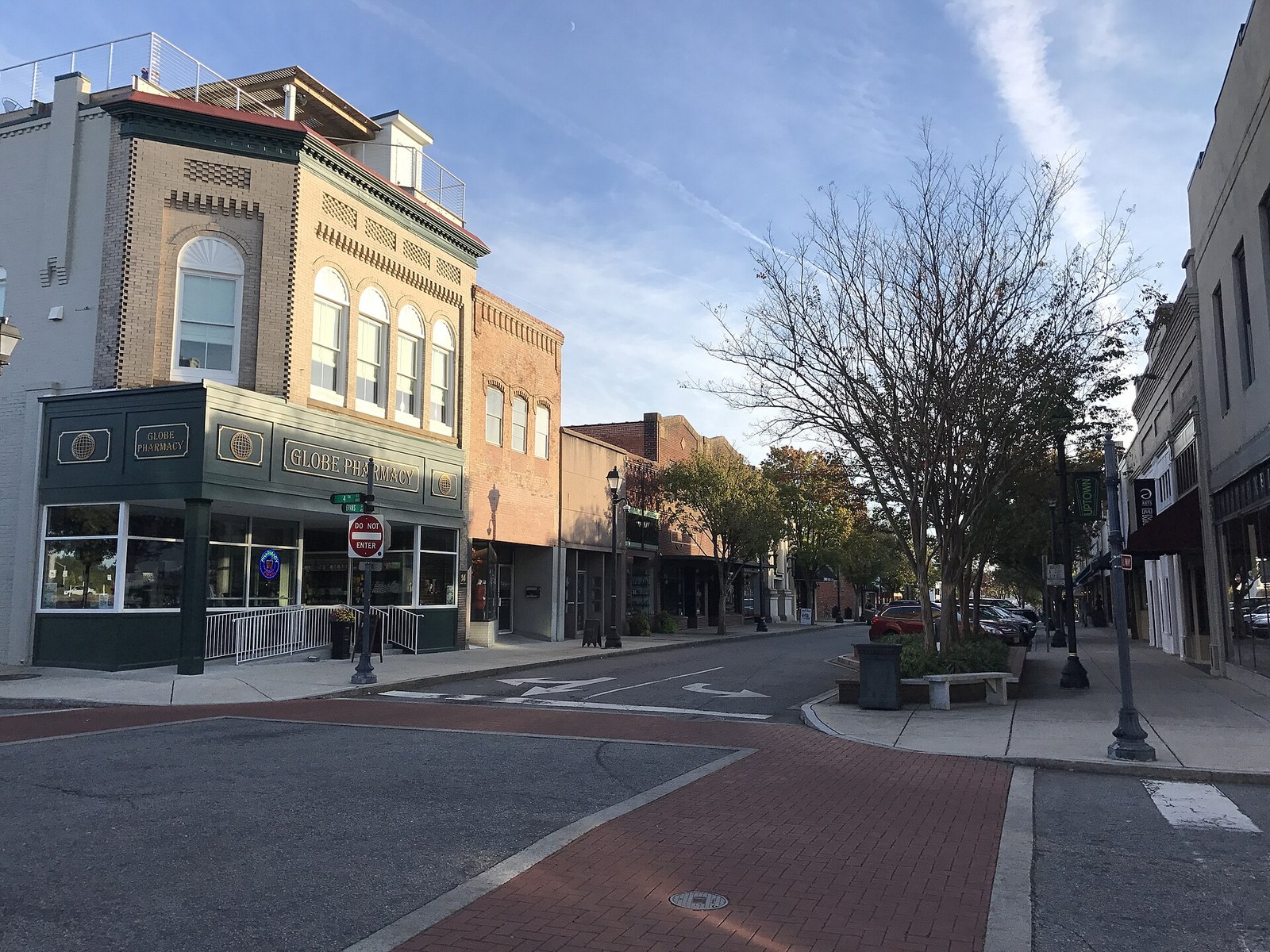 Downtown Greenville's Uptown district. Photo by Indy beetle, CC0, via Wikimedia Commons.
One more number from Raleigh
At a Small Business AI Forum in Raleigh on October 30, the U.S. Chamber of Commerce reported that 47% of small businesses say AI is creating jobs at their firms, versus 6% reporting headcount cuts. The winners pick one repetitive job and automate it first. Our post on training employees on the limits of AI covers the other half of that job: https://www.mcmgs.com/blog/how-to-train-employees-on-the-limits-of-ai
What to watch
- Mon, Nov 9: Davidson County votes on the Davie-Davidson rezoning, 6 p.m., Lexington; vendor questions due on the state AI procurement (RFP No. 800000).
- Tue, Nov 10: WhiteFiber reports third-quarter results.
- Fri, Nov 13: North Carolina certifies the election results; the recount window opens for the closest House races.
- Mon, Nov 16: Pitt County's moratorium hearing and vote, 6 p.m., Greenville.
- Mid-November: the Utilities Commission is expected to rule on Duke's rate cases and the large-load tariff, with new rates effective January 2027.
- Mon, Nov 30: proposals due on the state AI procurement. Mon, Dec 7: full applications due for the Rural Health Innovation Fund.
The week started with an election and ends with a deadline. The decisions that will shape your power bill are being made in hearings and orders over the next ten days, and most are still open to input. If you want help getting your business ready, start here: https://www.mcmgs.com/contact. We reply within 24 hours.
One transparent rate, quoted in writing before any work starts: no surprises, no open-ended billing. You pay for the work once and own it outright: no subscriptions, no licenses, no monthly fees to us.
Want the North Carolina AI and tech news that affects your business, in plain English, twice a week? Sign up for the NC Business Technology Briefing at https://www.mcmgs.com/blog.
North Carolina AI & tech news, translated into plain English.
At most twice a week, get the North Carolina technology shifts, grants, and practical automation guides that actually affect local businesses: what happened, what it means for you, and what to watch next. Stop with one-click unsubscribe or change your topics anytime.
Need Help Modernizing Your Operations?
Take our 2-minute interactive needs assessment and get a custom step-by-step action plan from McMillan General Services within 24 hours.